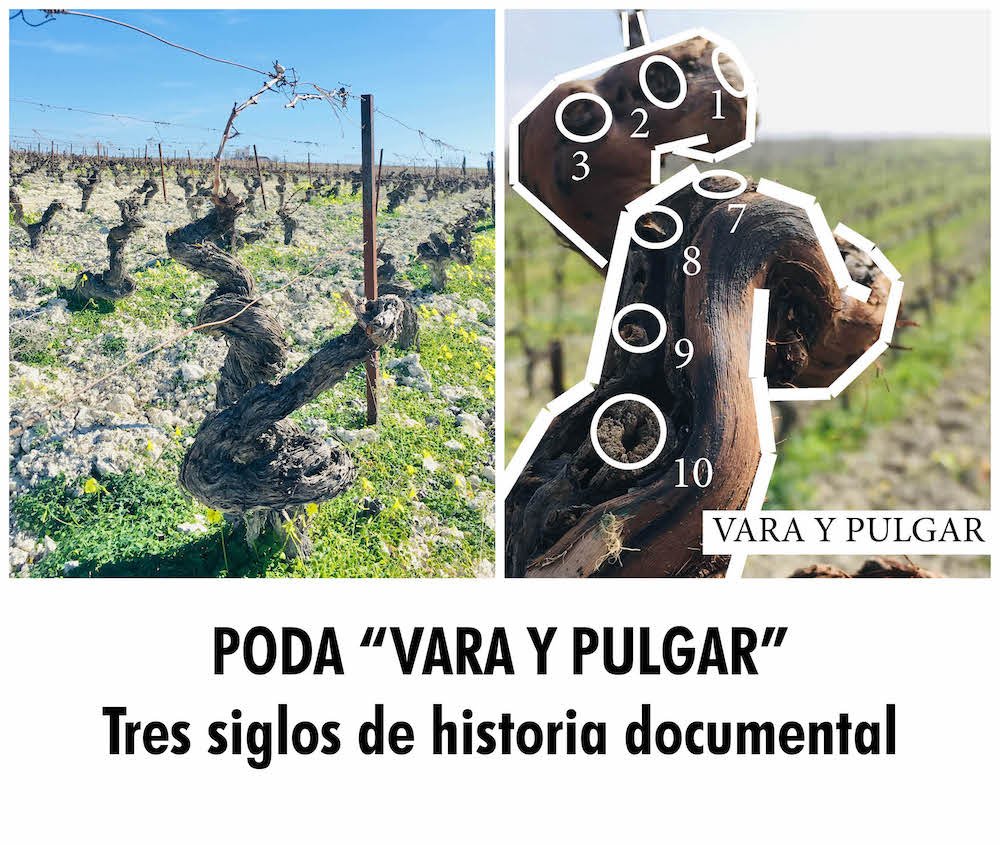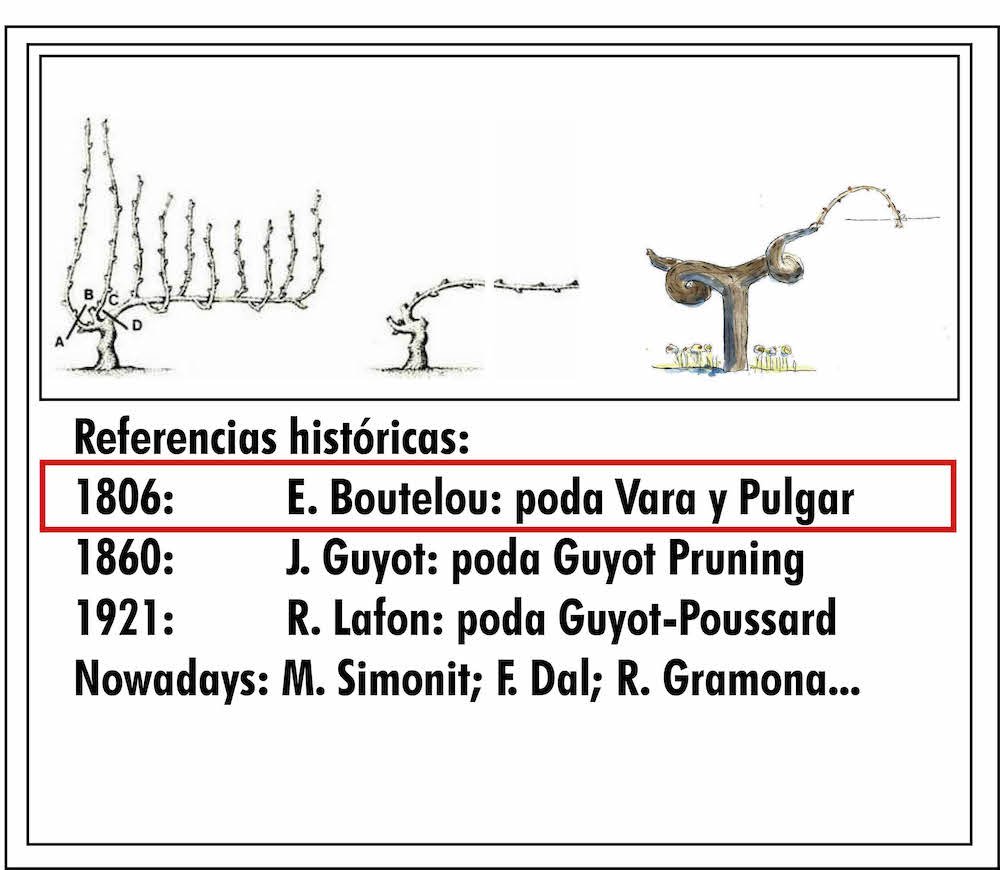
It is said that the traditional pruning of the Marco de Jerez, called Vara y pulgar, is like a simple Guyot; however, it would be correct to say it the other way round: the Guyot pruning is like the Vara y pulgar, as the documentary records are much earlier..
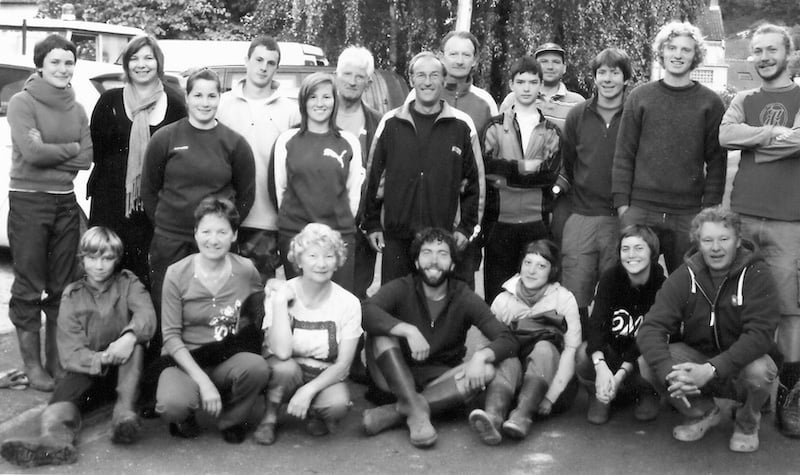
Pruning was invented and perfected by winegrowers, but the names that go down in history are those of the engineers who wrote them down. In this case, it was Esteban Boutelou, director of the Botanical Garden of Sanlúcar de Barrameda who in 1806 published “.“Report on the cultivation of vines in Sanlúcar de Barrameda and Xerez de la Frontera.”. In it, he not only described the Vara y pulgar pruning technique as a specific and technical pruning system, but also related the organisation that existed in Sanlúcar de Barrameda, with master foremen in each neighbourhood, who were in charge of teaching the technique to the workers.
This fact of having an organised formation indicates that the technique existed at least several decades earlier.
In the case of Guyot pruning, it was first described 50 years later in 1860 by Jules Guyot, in his book “The Guyot Pruning".“Vineyard culture and winemaking”. Curiously, the publication appeared after his work in the French sister region of the Marco de Jerez: Champagne.
More than a century after Boutelou's publication, in 1921, René Lafon published “Modifications à apporter à la taille de la vigne dans les Charentes. La taille Guyot-Poussard», in which he gave indications on the improvement of Guyot pruning.
In the case of Vara y pulgar pruning, there are other documentary references. One of the most relevant is the one published in 1834 by James Busby, the father of viticulture in Australia, who travelled around Spain and France in 1831 collecting data and material to import viticulture to the new continent. In his “Journal of a Recent visti to the principal Vineyard of Spain and France »The "The "Macharnudo" collection records a conversation with Pedro Domecq, owner of the Macharnudo estate at the time, in which one of the topics they discuss is the special pruning system for the care and maintenance of the vines.
Thus, Vara y pulgar pruning can be considered one of the first specific pruning techniques recorded. And its raison d'être can be explained from the particularities of the palomino grape vines, and from the climatic context of the Marco de Jerez.
On the one hand, the warm, Atlantic climate of the Marco de Jerez, with mild winters, causes the existence of a wood moth, known as “comején”, which was the main cause of the weakening of the vineyards. For this reason, they selected a pruning system that would minimise the cuts, as it is through them that the insect penetrates the plant. Also, the maximum compaction of the vine generates a harder interior wood, which prevents it from attacks.
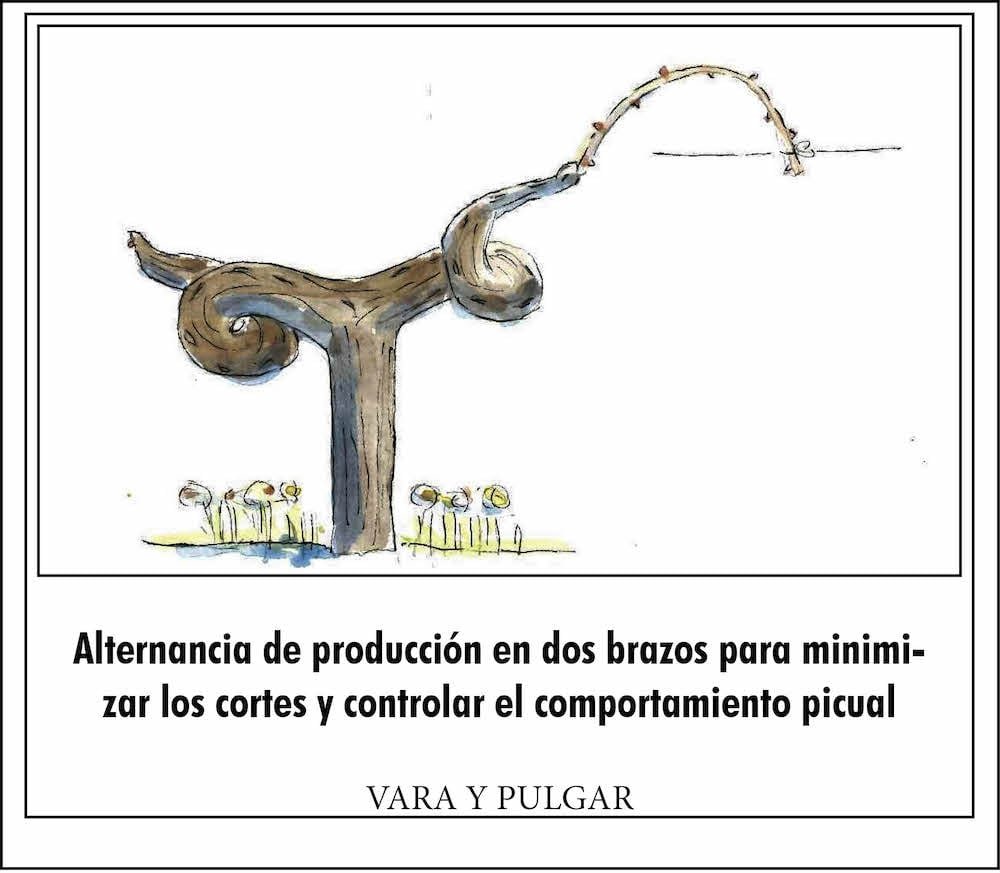
On the other hand, palomino vines have two specific behaviours: on the one hand, it has a picual behaviour, with a sprouting that always pushes harder on the buds at the ends of the cane; and on the other hand, the first buds are not very productive, so it requires followers or canes with at least five buds to obtain ideal bunches.
These particularities were the basis for the design of the Vara y pulgar pruning system, which, by alternating the grape load in two arms, solves the picual and productive behaviour, and with the use of a single rod, minimises cuts..
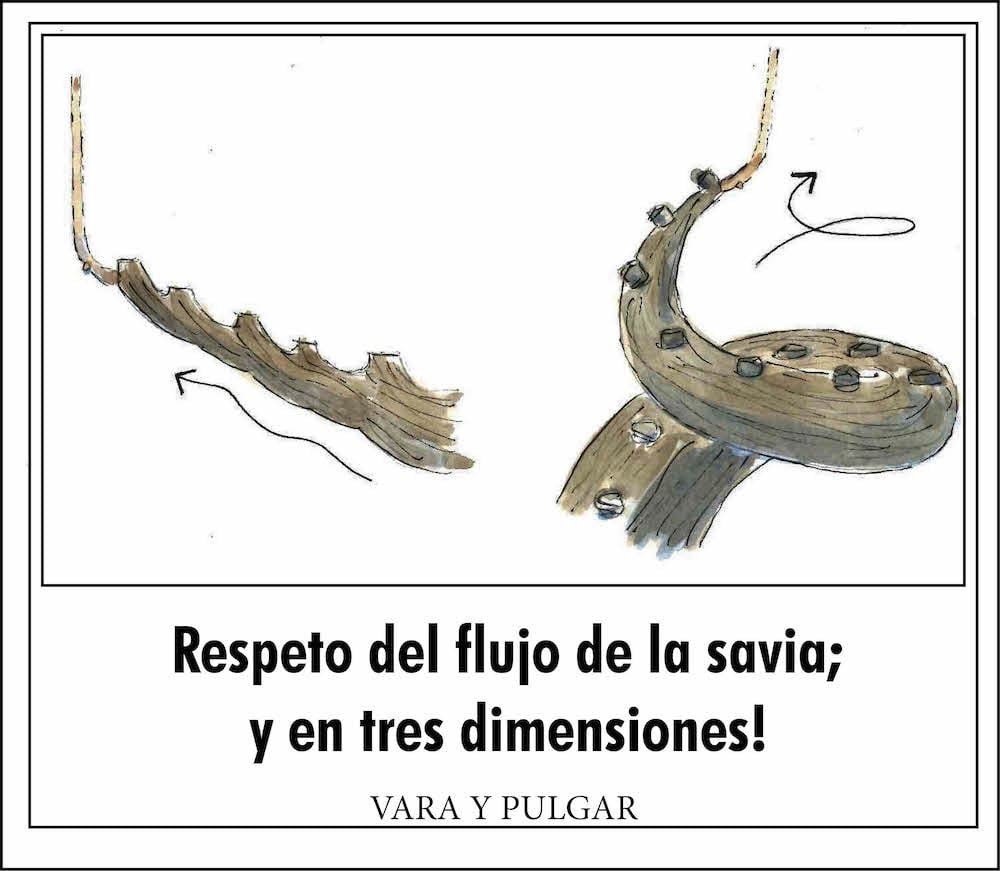
But the technique does not end there. It also incorporates all the principles of healthy pruning that are currently being revalued by leading pruning experts (Dal, Simonit, Bourdarias, Gramona, among others): respecting the sap and the dry run; long cuts to respect the sap, cleaning of dead wood, etc.
However, Vara y pulgar pruning would require a more extensive publication in order to know all its details and particularities, We outline at least eight basic points to understand its value and the accuracy of its design:
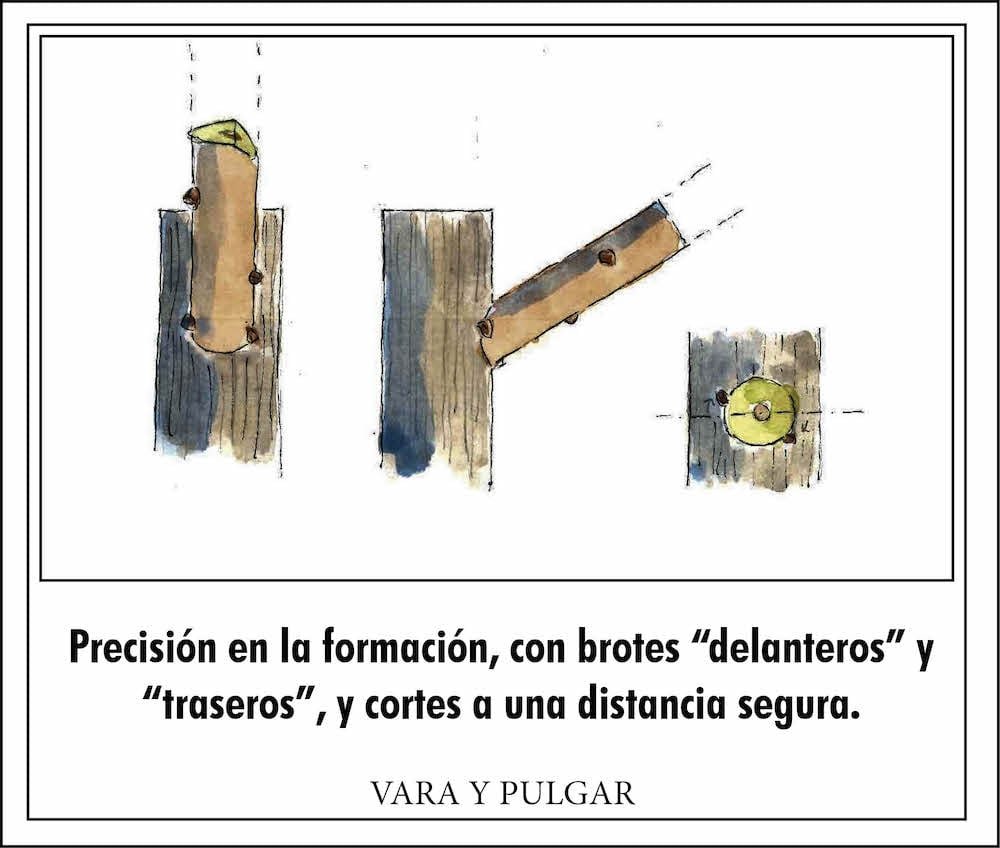
- It respects the run of the sap, or as they say locally “the run of green”, and also does so in three dimensions, with attention to and distinction of the bud burst in “flat” (left and right) or “crossed” (up or down).
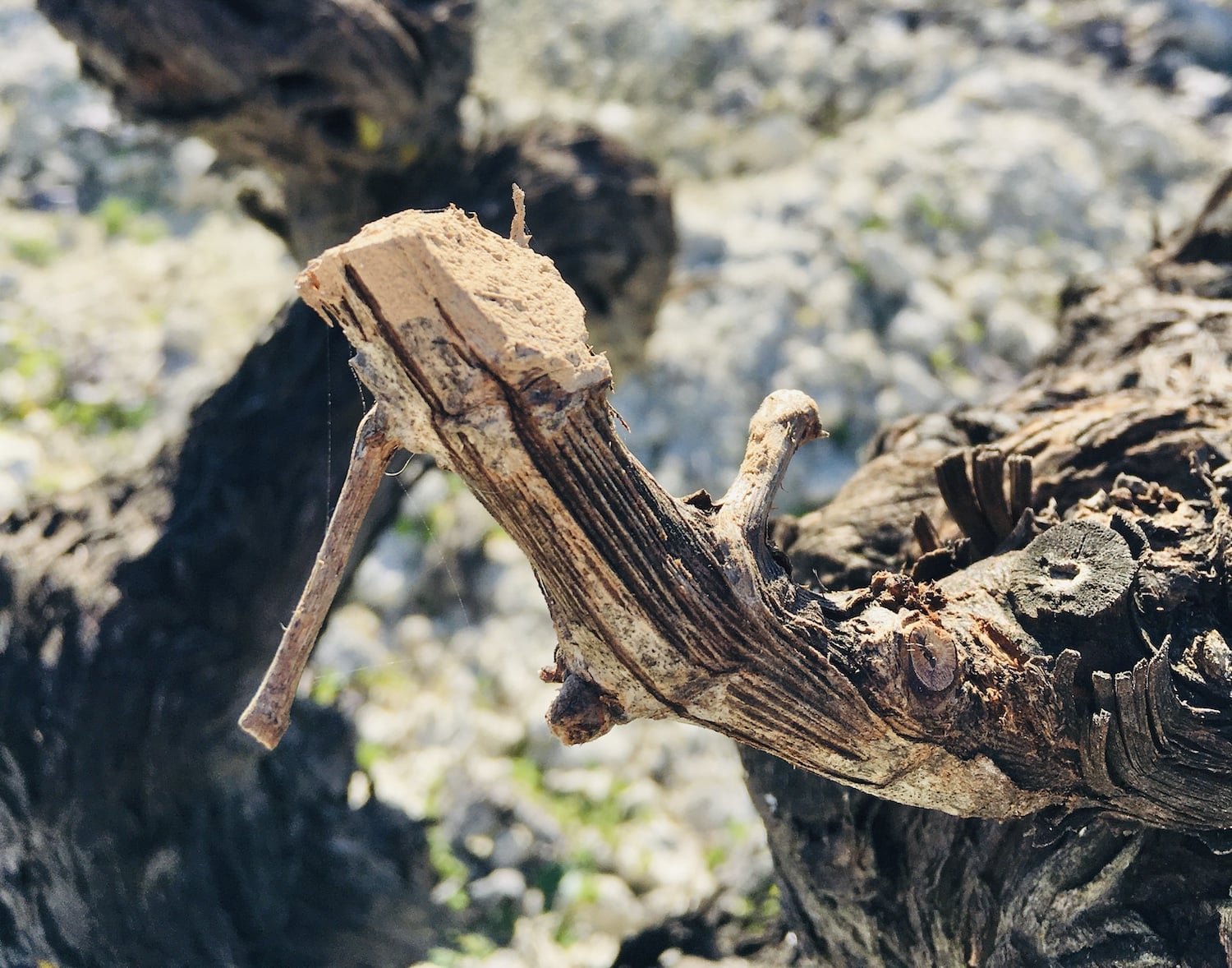
- Alternate productive loading of the two arms, minimising major cuts to a single cut, which is usually sealed (formerly with iron sulphate; nowadays with healing pastes).
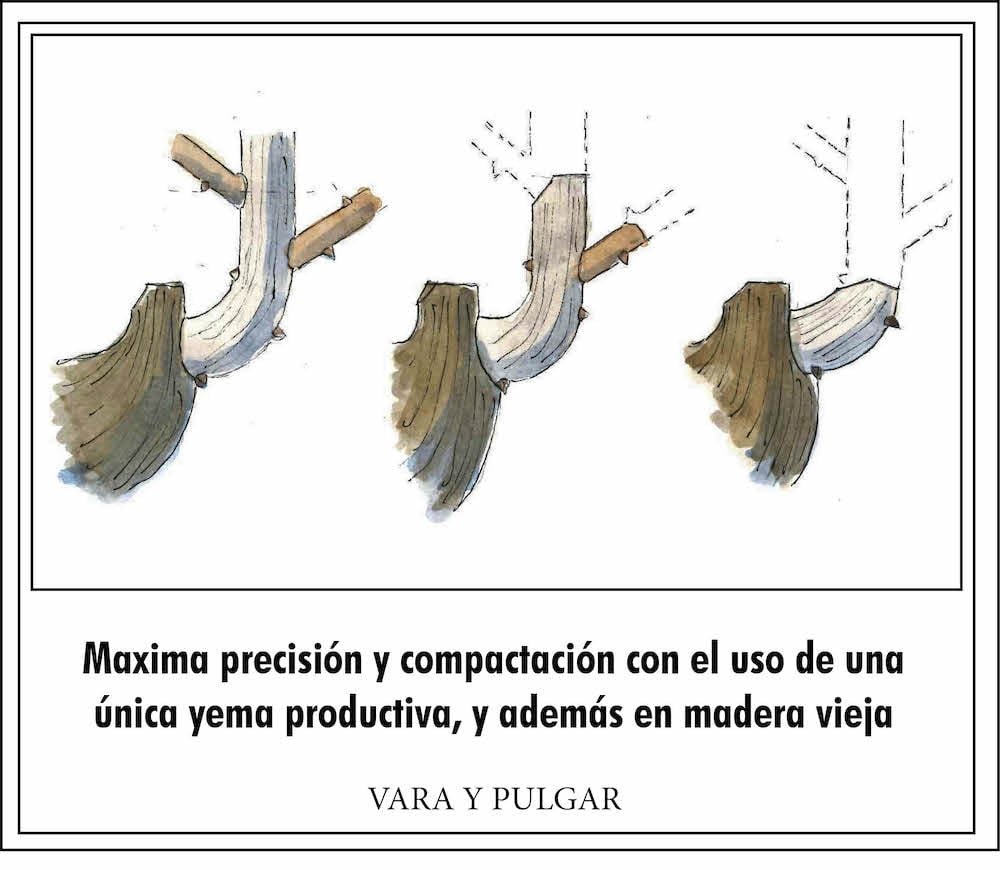
- It offers maximum precision with a single thumb or bud, playing “one card at a time”, as opposed to other pruning methods, which aim to have several alternatives, but which lose power.
- It achieves maximum compacting of the wood by using the bud on old wood, as opposed to other pruning methods, which play with young wood of one year old, to ensure sprouting.
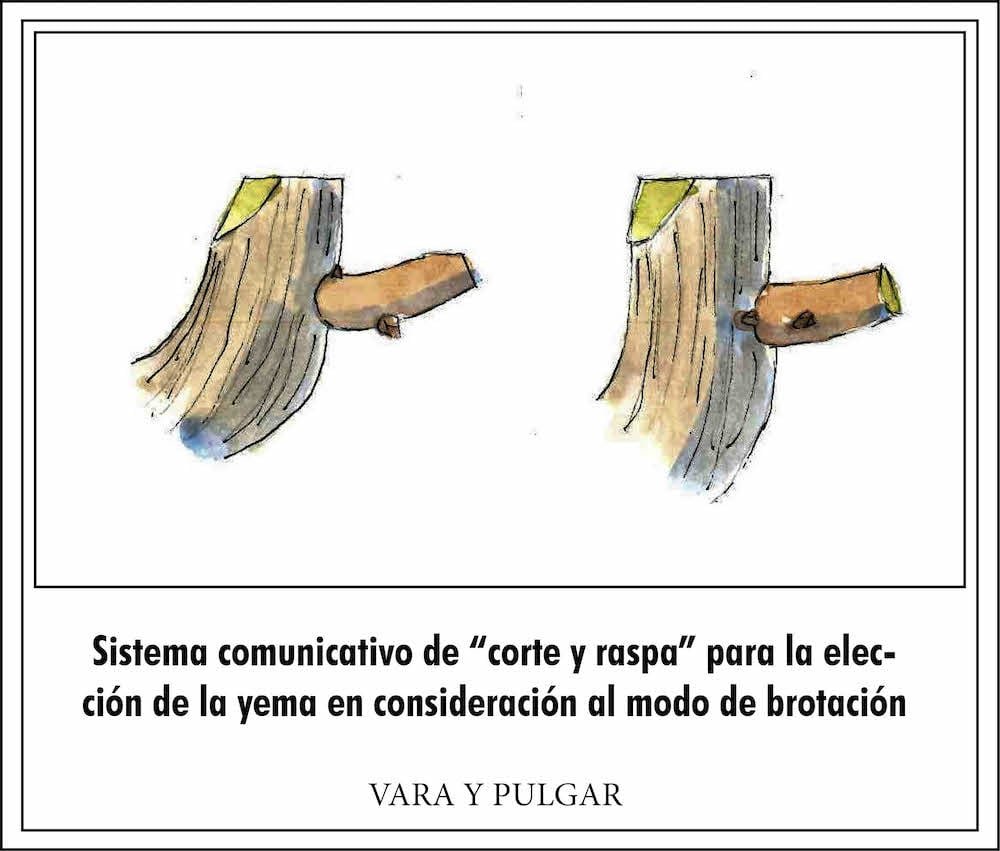
- It incorporates the use of cuts at a prudent distance so as not to damage the vine (avoiding always cutting close to the sap flow) and with a communicative system of “cut and scrape”, which allows speeding up the green pruning steps.
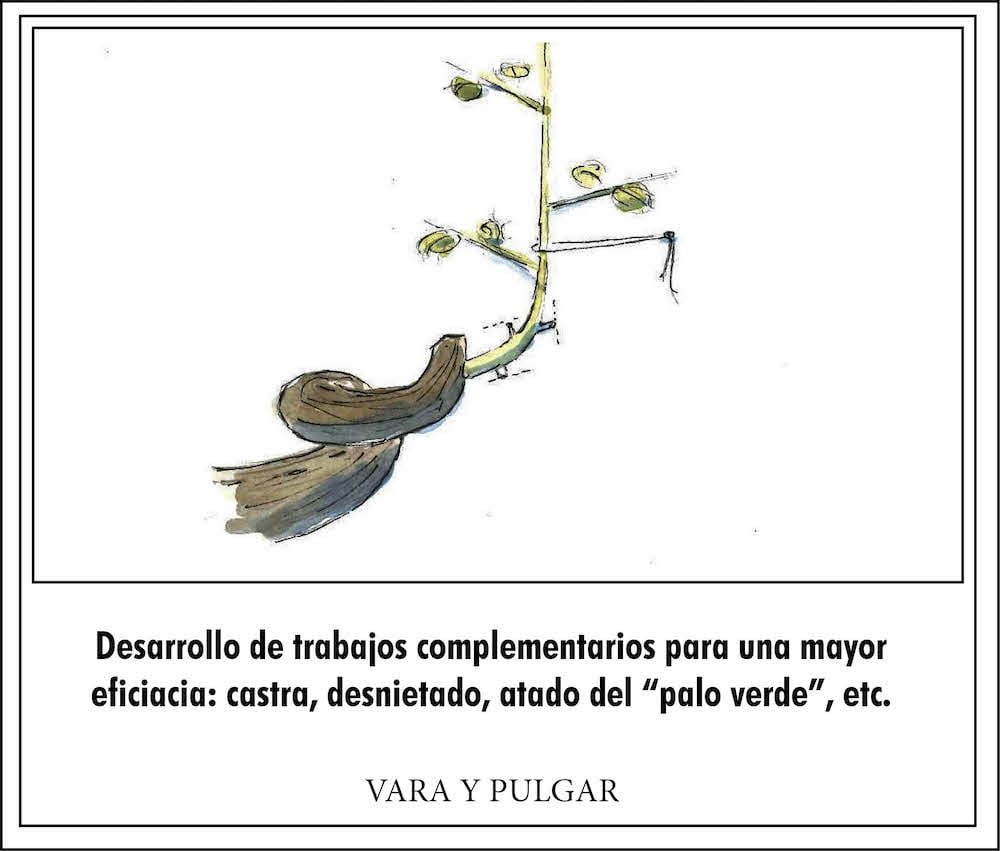
- It carries out complementary tasks to improve efficiency: castration, dehorning and tying of the “palo verde”.
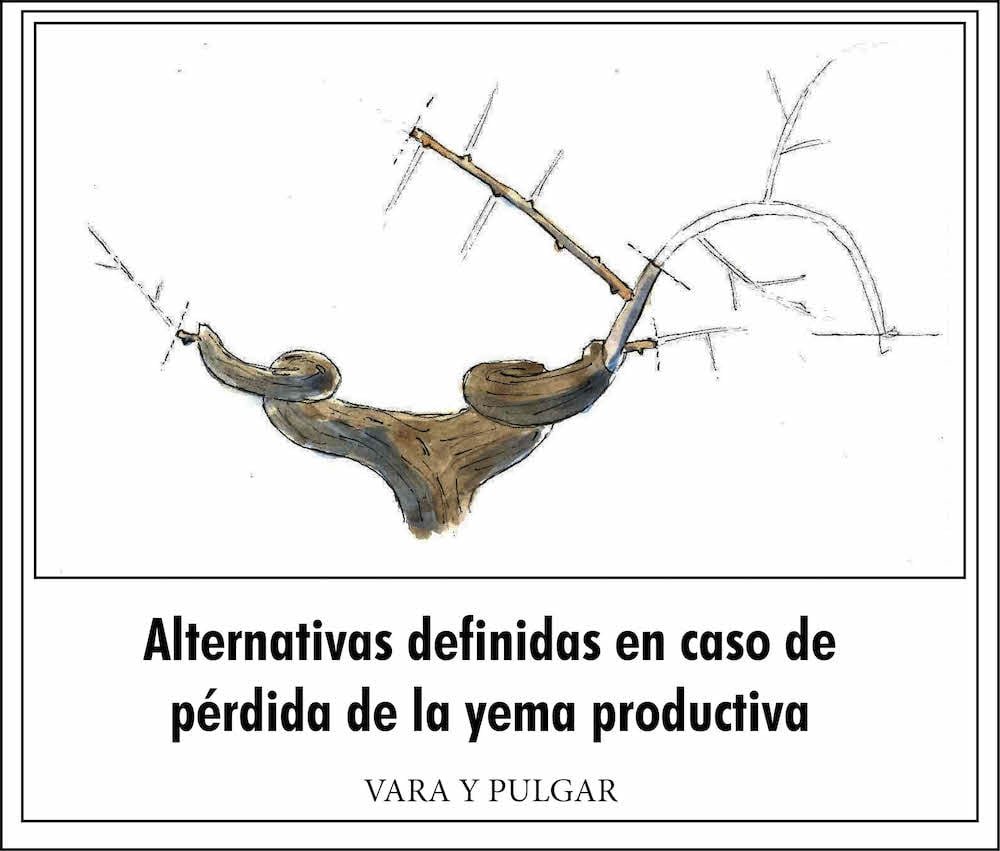
- Defined alternative responses in the event of loss of the thumb: green grapes, scarified grapes, scarified grapes with arrival, round pruning, etc.
- Principles established for the formation of the plant by “grandchildren” or by “faithful”, aiming at a crossed sprouting, even with a “heeling” for the first “flat” sprouting.
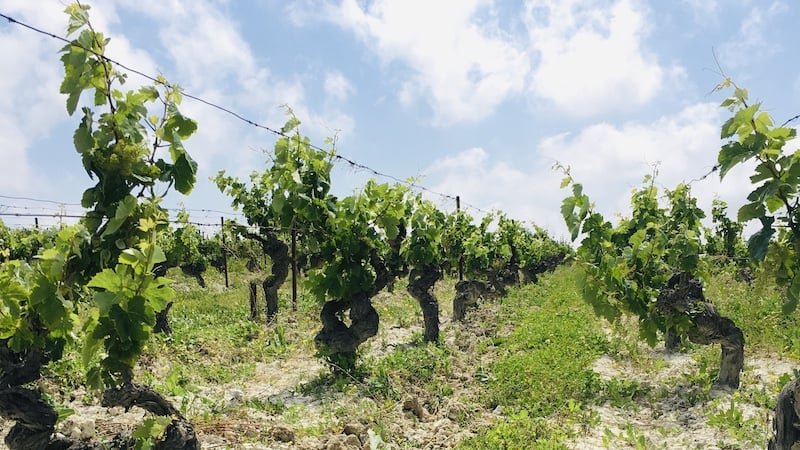
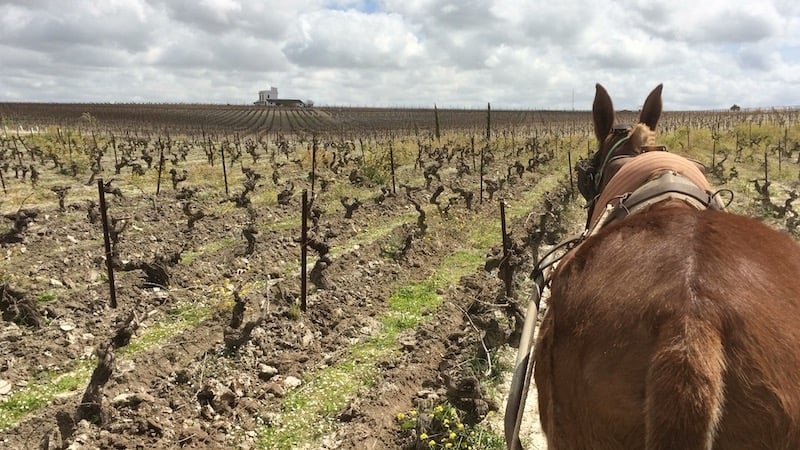
Even today, in the Marco de Jerez, the Vara y pulgar pruning is the most common pruning used by winegrowers, although the large estates are switching to “double cordon”, as the Vara y pulgar pruning is not suitable for pre-pruning mechanisation and machine harvesting. It also requires specialised workers, of which there are fewer and fewer in the area. Double cordon“ pruning has the advantage that it allows mechanisation and that unskilled seasonal workers can be employed. The disadvantage is the life of the vines, which have to be uprooted and replanted after 30 years. On the other hand, with ”stick and thumb“ pruning, the vines can live for more than 100 years.
In my case, I have had the good fortune to learn “Vara y pulgar” pruning from great Sanlúcar winegrowers such as Juan Morales, Juan Peregrino and Ignacio Partida, among others. Sanlúcar de Barrameda and Trebujena are probably the places where the greatest winegrowing knowledge of the Marco de Jerez region is to be found.; This is where there is the most “liking”, where the technique has been perfected the most. Each village, each estate and each winegrower has an identity in the way they conceive pruning and vine training.
All this knowledge is an enormous asset to be properly valued.